
Children’s House
(3–6 years)
The Children’s House is a mixed-age environment carefully designed to nurture the child’s need to explore the world, care for themselves, and learn. Children move freely and make independent choices as to what activities they will engage in, where they would like to work, and who, if anyone, they would like to work with.

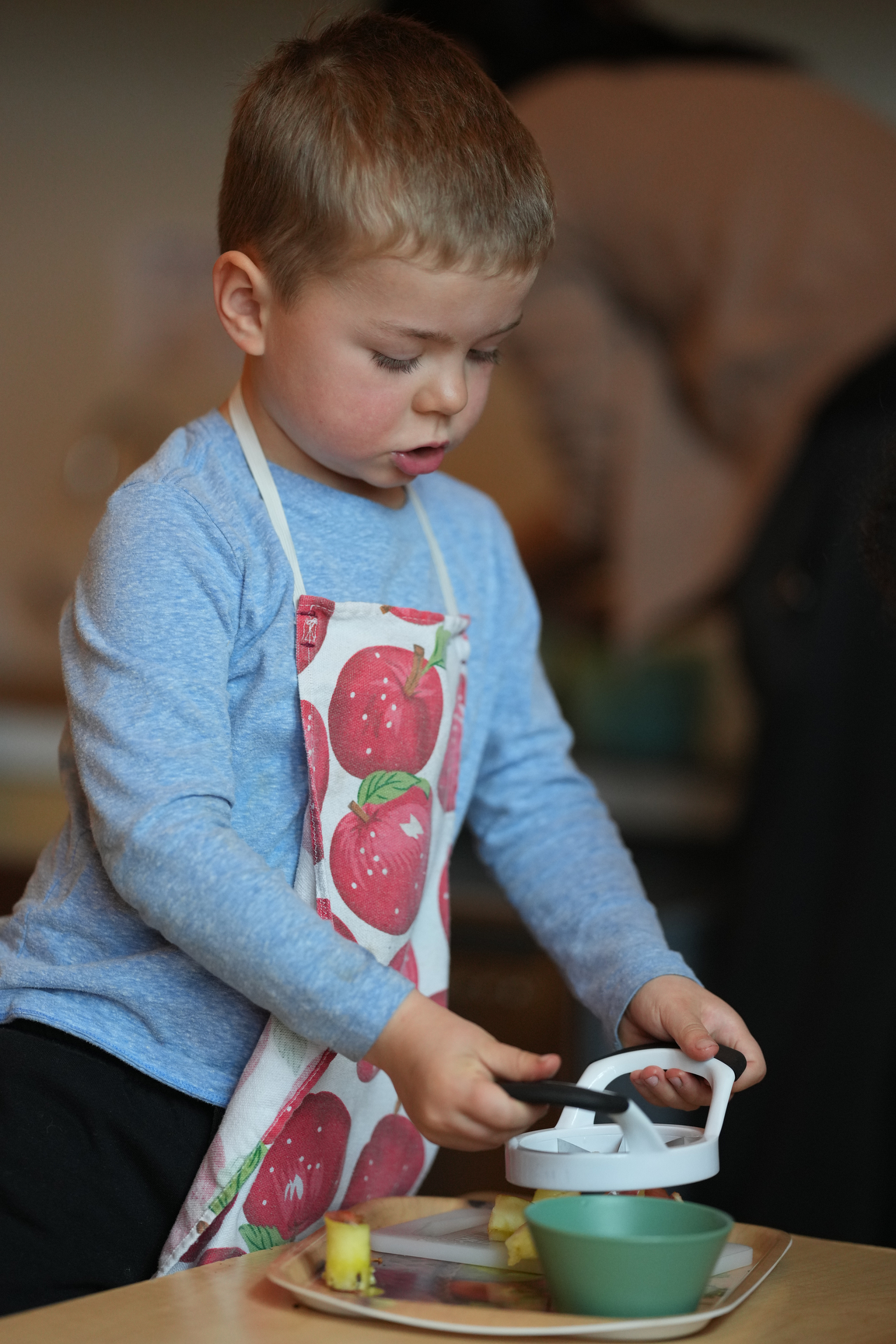
Practical Life
When observing a Montessori classroom, you may see a child preparing herself a snack of sliced banana. Another is carefully trimming and watering the plants. Two children may work side by side, sewing buttons and polishing glass objects. These are all examples of Practical Life activities. The materials are designed to give children the opportunity to care for themselves, others, the classroom space, and beyond!
Sensorial
Children at this age absorb the world through their senses, touching things as they pass by, smelling flowers, and trying all different ways to taste!
Dr. Montessori observed this behavior and created materials to help facilitate this sensorial need. Each sensorial material is designed to bring awareness to the many different sensorial qualities of our world.


Language
Language is everywhere in the Children’s House. All the materials offer an opportunity for building vocabulary, whether it be naming objects in the environment, looking at language cards, identifying flags from around the world, or studying the life cycle of a butterfly. The sounds and symbols of our language are introduced with sandpaper letters, providing a multi-sensorial learning experience, and shortly thereafter, children begin writing using the moveable alphabet. From there, the child explodes into the world of writing and reading. One child might be making a book of different animals, labeling each illustration, while another might be researching different phonograms, identifying the sound /sh/ in a book.
Math
Dr. Montessori observed the preschool-age child’s natural mathematic abilities. She designed activities which isolate the different mathematical concepts and allow the child to explore them through the use of concrete materials. Children develop a deeply sensorial understanding of quantity, associate names and symbols with ease, work with large numbers from one hundred to one million, and start on the path of memorization and even long division. The beauty and simplicity of the materials, the opportunity to work in a group, and the many avenues of discovery make the math area a truly fun place to be!
